Few electrical issues in a house are as potentially dangerous as an electrical overload. Overloads can melt wiring, causing arcing, shocking people, and damaging appliances. Here is what you should know about home electrical overloads and how to identify them quickly.
Panels, Circuits, Wiring, and Overloads
It is important to understand what is being overloaded. Your home’s electrical system starts with its circuit panel. The circuit panel takes the electricity from the service entrance, meaning where your utility company connects to your house, and distributes power to various parts of your home.
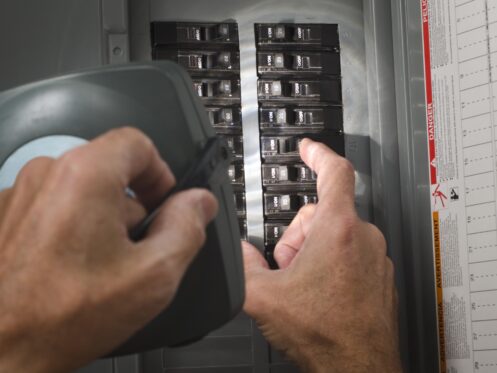
Circuit breakers separate the electrical flow into sections that then go to specific areas, such as the kitchen or HVAC. They also have switches that automatically flip off when overloaded. Likewise, you can switch them off manually to cut power to a specific part of the house.
One of the big safety issues involving overloads is wiring. Wires carry the electricity from the circuit breaker to outlets, lights, and heavy appliances in rooms. If a circuit is overloaded, the heat can melt the wiring and create a fire hazard.
Amperage
Most homeowners can focus on a single number. The rated amperage of a circuit tells you how much load can flow through it safely. Note that the rated amperage of a circuit breaker and a wire should be the same to avoid overloading the wire. An overload occurs whenever any part of the system exceeds its rated amperage.
In most household circuits, the rating is either 15 or 20 amps. This is perfectly good for lighting, electronics, and even small appliances in most rooms. Many rooms even share a circuit because they have low electrical demands. For example, it is common for bedrooms, living rooms, and entertainment rooms to run on the same circuit as one or more other rooms.
Higher amperages are necessary for heavier applications. For example, a whole-house HVAC for a large house could easily require a 60-amp circuit breaker. This is because the system can pull a lot of electricity when it starts its cycle. Other systems frequently use dedicated circuits. Refrigerators, dryers, electric stoves, washers, and freezer chests often get their circuit or share their circuit with perhaps one other device.
The amperage of an electrical circuit breaker panel matters, but in a different way. The panel needs to support enough power for everything in the house. Generally, our electricians try to leave about 20% overhead. For most households, this means installing a 200-amp panel in anticipation of about 160 amps of peak concurrent demand.
How to Spot Electrical Overloads
Visible Signs
People tend to notice the visible signs of an overload. A classic example is flickering lights. If the lights in one part of a house flicker, there’s a good chance a specific circuit is overloaded. If you see flickering lights throughout the house, then the odds favor a panel overload.
The heat from an overload doesn’t always cause arcing or fires. Some overloads warm outlets and light fixtures, leading to outlets and light sockets browning or blackening. In spots where wiring is visible, usually in basements and service areas, you might also see darkened or even bare wiring caused by heat melting insulation.
Overloads can also cause a total loss of power. This may be localized to a particular circuit. However, a whole house can also lose power. Typically, you can inspect the electrical panel and see at least one breaker flipped to the off position that shouldn’t be. Our company labels the circuit breakers, so homeowners know which ones send electricity to specific sections of the house.
There is also a main circuit breaker for the whole house, usually at the top of the panel. You might see that it’s flipped off if there is a total power loss in the house.
Auditory Indicators
Electrical overloads tend to cause a buzzing or sizzling sound. You may hear these near outlets or light fixtures. Similarly, such sounds come from overloaded circuit breakers and panels. Even appliances and electronics can emit sounds that indicate an overload.
Performance Issues
Overloads can also trigger subtler problems. An overloaded circuit might not distribute enough power for all the devices on it. For example, an aging circuit with a washer and dryer on it might struggle to keep up with system demand. This could lead to the washer and dryer taking longer to do their jobs. Also, it might shorten the expected service life of those appliances.
You may notice that certain systems just can’t operate at the same time. Suppose the electrical panel is overloaded. Someone in the house could be doing laundry. When someone in the garage turns on an air compressor, that might cause a circuit breaker to trip or turn off the whole panel. If this regularly happens, then your house likely requires some attention.
Addressing Overloads
The solution mostly depends on the nature of the problem. If a single circuit is overloaded, then our electricians might simply install an additional circuit and run wiring to support it. This might happen if a household that never had a dishwasher adds one to a circuit in a kitchen. Maybe the dishwasher shares that circuit with the refrigerator or an electric stove. In that scenario, it might be best to assign a circuit to each appliance to maximize capacity, performance, and safety. Most panels have empty slots, so this is likely an option if the panel is modern enough and has enough capacity.
We also check to see if the circuit breaker and wiring are in good shape. These components age, and they can lose some of their capacity due to heating and cooling issues. Physical damage can also harm components. In some cases, the solution is as simple as putting in a new circuit breaker or putting in properly rated wiring.
An overloaded electrical panel may require an upgrade. This problem is most common in older houses because they often have panels that support 100 amps or less. People often don’t notice the problem if they don’t run lots of high-draw systems concurrently.
We usually recommend removing the old panel and adding an upgraded electrical panel with a higher capacity. In most cases, a 200-amp panel will do the job. However, a household that’s adding more modern electrical demands might want to go higher. For example, Level 2 EV charging stations can easily add 40 amps of demand that runs concurrently with other high-draw devices.
General Air Conditioning & Plumbing has been in business since 1984 and is a fully licensed and insured residential electrician. We are a local business that’s proud to provide a fast response. Our well-equipped vehicles serve as a warehouse on wheels. We offer upfront pricing for a variety of projects, including electrical installations, repairs, and maintenance. You can have us work on electrical systems like EV chargers, panels, wiring, lighting, and whole-home generators.
If you’re concerned that your residence in Palm Springs, CA, or the Greater Coachella Valley has an electrical overload, contact General Air Conditioning & Plumbing right away.