The filter inside your HVAC system in Thousand Palms, CA helps to boost your indoor air quality (IAQ) by removing unwanted airborne contaminants. It’s important to remember that your filters are effective only when they’re free of debris. Understanding when your filter needs changing can help you maintain good air quality without affecting system performance.
How Does the Desert Climate Affect Air Quality?
One of the biggest problems with desert climates is that they’re so dry that they allow particles to remain suspended in the air. In coastal or humid regions, the moisture weighs down airborne particles, leading to better air quality. To make it worse, the desert climate has wind events that can carry fine sand and other debris into your home. Even the smallest gaps around your doors and windows can become entryways for these fine particles.
The Job of Your HVAC Air Filter
The filter for your HVAC system serves three primary purposes. The first is to capture dust, pollen, and other airborne debris. The second is to protect the internal components of your HVAC system from particle buildup. This ensures efficient and safe performance from your system throughout the entire summer season. The third is to support healthy IAQ.
When your filter reaches the end of its lifespan, clogged with debris, it can decrease the airflow in your system. This will strain your HVAC system’s components, degrade your indoor air quality, and make your system more susceptible to a breakdown.
When Are Filter Changes Necessary?
In general, most homeowners find that they need to replace their pleated air filters every 30 to 90 days. However, living in Thousand Palms’ desert climate typically requires more frequent air filter changes. This is due to a combination of running your air conditioner for extended periods and higher-than-average outdoor dust levels.
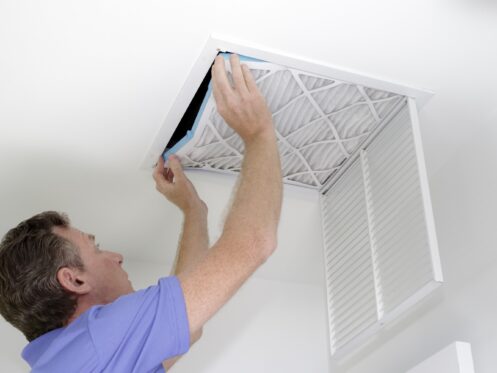
Most homeowners in your area find they need to replace their air filter about every 30 to 60 days. You may find that you need to replace yours more frequently during the Coachella Valley’s windy seasons. Plan on checking your filter once a month by holding it up to a light and looking through it. If you can’t see through it anymore, it’s time for a replacement.
We suggest keeping a spare filter on hand so that you can replace a dirty one whenever necessary. All HVAC filters have a rating on the minimum efficiency reporting value (MERV) scale. The higher the rating, the more filtering capability the filter has.
A filter with a MERV rating between 8 and 10 is typically a good range for the average home. If you or another member of your household suffers from asthma or allergies, consider a higher-rated filter between MERV 11 and 13.
If you’re not sure which filter is best, ask one of our technicians at General Air Conditioning & Plumbing about the right MERV rating for you. They can suggest a filter that will remove enough contaminants without restricting the airflow in your house.
Factors to Determine Filter Change Frequency
There is no one-size-fits-all solution when it comes to determining the appropriate time frame to change your air filter. Several factors can influence how frequently you need to change your air filter.
One of the biggest concerns is the desert dust level in your home. If your home is near open land or an unpaved area, you’ll typically experience more dust intrusion. This means your home will need more frequent air filter changes than a house in a suburb. If you have asthma, allergies, or respiratory sensitivity, you’ll likely need higher-rated filters as well.
Pet hair and dander can quickly fill your HVAC air filter. Homes with pets will need more frequent air filter changes than homes without. Another big factor that influences air filter change frequency is your HVAC usage patterns. The more often you run your HVAC system, the more often you’ll need to change your air filters.
Dust, fabric fibers, skin cells, and other particles all stir up when people move through your home. If you have several household members, you’re more likely to kick up more airborne particles. This means you’ll need to replace your filter more frequently to ensure it’s doing its job.
Key Signs You Need to Replace Your Air Filter
There are several key warning signs that you need to replace your air filter soon. If you notice a visible gray or brown dust coating on the surfaces throughout your home, it’s time to replace your filter. Worsening allergy symptoms, higher-than-normal energy bills, and longer AC cycling all indicate you need a filter change. You may also notice reduced airflow coming from your various vents.
A Note About the Windy Seasons
The Coachella Valley experiences heavy wind gusts during the spring and fall. During these windy periods, it’s important to be mindful of your airborne dust levels and air filter. Check your filter every two or three weeks. With the increase in airflow and airborne dust levels, you can expect it to clog faster.
IAQ Add-Ons
While keeping up with routine filter changes and investing in quality air filters are great habits for boosting your indoor air quality, there are other options to consider. There are IAQ add-ons you can put on your HVAC system to further enhance your indoor air. These can be great for homeowners who have severe respiratory conditions.
A popular option is a whole-home air purification system. A technician will install this inside your return ducting to treat air as it flows through your ductwork. Many air purifiers have integrated UVC germicidal lighting. This disrupts the DNA of pathogens, bacteria, and viruses, preventing them from reproducing in your home, and causes them to die off.
Electrostatic filtration systems are another option that uses metal plates to remove airborne contaminants. These require frequent cleaning of the plates to ensure optimal system efficiency. It’s also a good idea to consider a duct cleaning service every one to two years to remove any buildup of debris inside your ductwork.
Other Tips to Enhance Indoor Air Quality
Apart from indoor air quality solutions and routinely changing your HVAC filter, there are some other things you can do to ensure good indoor air quality. One of the most important is scheduling routine HVAC maintenance. We suggest scheduling this in early spring to prepare your system for the upcoming summer season. It can be helpful to seal up any air leaks on your exterior walls to prevent unwanted dust infiltration. These are most common around your door and window frames and the light switches and outlets on your exterior walls.
Reliable AC Maintenance Service
General Air Conditioning & Plumbing provides reliable AC maintenance service for Thousand Palms and the surrounding areas. We can also help with all your cooling system repair, installation, and replacement needs.
Call our team at General Air Conditioning & Plumbing today to book your next service call!